On 27 September 2021, Julie Pellegrin and Louis Colnot presented the study on Artificial Intelligence and Urban Development during the European Parliament's Committee on Regional Development meeting.
The study explores the state of available knowledge regarding the role of Artificial Intelligence (AI) within urban development, its potential advantages and risks, and the foreseeable implications for socio-economic and territorial cohesion.
The research highlighted that AI in an urban context can provide numerous solutions, from improved urban management to the release of new or improved services for citizens and the creation of new economic opportunities.
Along with the full study, translations of the executive summary are available online in French, German, Italian, and Spanish.
AT A GLANCE - Artificial Intelligence and Urban Development
On 22-23-24 September 2021, CSIL organised a webinar on KEEPING PACE WITH CBA: Investment appraisal for the Next Generation EU. Over 100 professionals attended the webinar in its three sessions. Participants were scholars, EU and national institutions officers and consultants, who connected from 19 different European countries.
The three sessions focused on using CBA in the context of the 2021-2027 Multiannual Financial Framework (MFF) and Next Generation EU, with real cases on key investment sectors: healthcare, energy efficiency, RDI, digitalisation.
On the first day, Henrik Andersson talked about the Society for Benefit-Cost Analysis; Julien Bollati presented the work of the European Climate, Infrastructure and Environment Executive Agency (CINEA) and the role of CBA in assessing energy projects.
Witold Willak (DG REGIO) and Davide Sartori (EIB) presented the new Economic Appraisal Vademecum, and the session closed with practical experiences from Lithuania, France and Slovakia.
On day two, American economist W. Kip Viscusi, one of the world's leading authorities on CBA, delivered a lecture on evaluating mortality risk reduction, with a case history on COVID-19. Jessica Catalano discussed the pandemic impact on the Social Discount Rate estimates in EU countries; EIB officers shared their experience evaluating energy efficiency and ICT investments.
On the last day, professor Phoebe Koundouri, a global leader in sustainable development, presented a social cost-benefit analysis and sustainability investigations for OpenAIRE: the European Open Science Infrastructure. Researchers from CSIL and the University of Milan discussed project evaluation of Research Infrastructures, investments in physics and the space sector.
CSIL experts regularly apply Cost-Benefit Analysis in different sectors. We look forward to share knowledge and experiences, also organising and participating in further online and in-person events. As soon as possible and safe for everybody, we will launch the 10th edition of the Milan Summer School on Cost-Benefit Analysis and other training.
The Regional Development (REGI) Committee of the European Parliament published a new study authored by CSIL that looks at the impact of Artificial Intelligence on Cohesion Policy, its role within and between urban areas. It explores the state of available knowledge regarding the role of AI within urban development, its potential advantages and risks, and the foreseeable implications for socio-economic and territorial cohesion.
Read the research4Committee blog post
Full study: Research for REGI Committee - Artificial Intelligence and Urban Development
Over the past year, CSIL has worked with Prognos, Digital Science, and various country experts to screen and assess all available smart specialisation strategies in the EU. The project's final report "Prioritisation in Smart Specialisation in the EU", will be presented on Thursday 2 September 2021. The report also includes the newly developed "S3 Scoreboard". The authors will discuss the study's findings and their implications for EU policy together with EU officers and academics.
To attend, please register on the European Commission's website.
We are looking for a new colleague who will contribute to the management of public tenders, international contracts, and EU-funded projects and take responsibility for the smooth running of administrative, financial, and legal matters.
Contract type: part-time (20 hours a week)
Main location: Milan
Deadline: 10 September 2021.
The ideal candidate is responsible, systematic, and attentive. This person will be expected to refine our projects' finance and administrative practices and recurring workflows proactively. The officer will be working mainly under the guidance of the Managing Director and will liaise with team leaders in project-related administrative matters.
Please, email your CV and cover letter to careers@csilmilano.com or submit them using our website form.
Alessandra Caputo, Emanuela Sirtori and Domenico Scalera authored a working paper that aims at identifying geographical patterns of Biopharma transformation trends in the EU over the period 2000-2016 through an analysis of cross-regional and cross-sectoral linkages. To this purpose, information on co-patenting, mergers and acquisitions, and joint ventures and alliances is used to carry out a network analysis at the region level. Results show an increasing involvement of European regions in cross-sectoral Biopharma operations. However, while the network displays a tendency to enlarge toward the East (Poland) and West (Spain), a significant reduction in the activity of peripheral nodes in the Southern and Northern borders of the network is observed. More recently, the overall interconnectedness of the network slightly decreases; the network becomes sparser, showing a propensity toward regionalisation of cross-sectoral linkages. Finally, by exploiting information on the location of companies and inventors involved in cross-sectoral operations, the investigation allows pinpointing regional communities and their evolution throughout the years.
Read the full working paper or read it on RePEc.
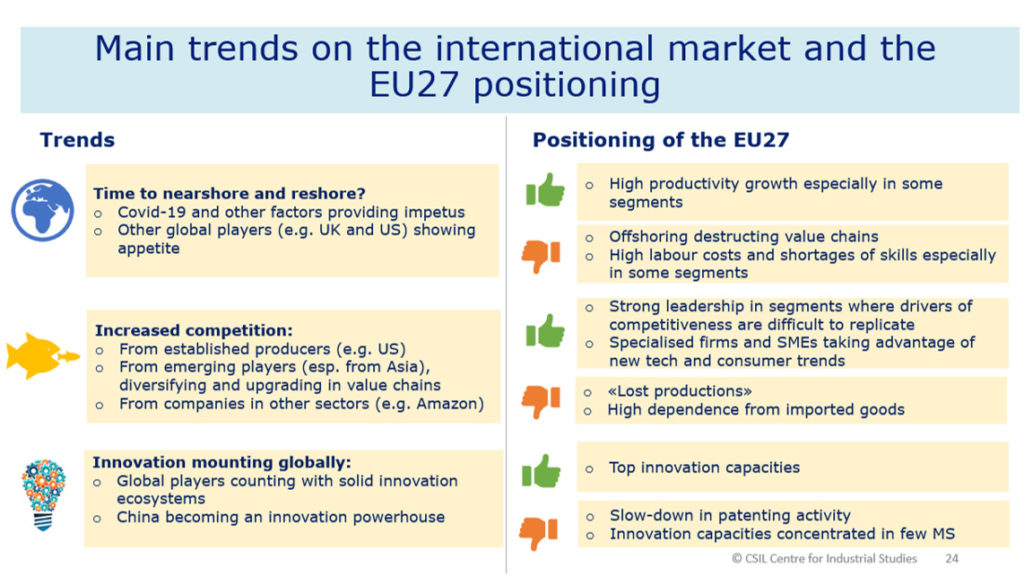
CSIL organised a workshop to present the preliminary findings of the ongoing study “Data in the EU textile ecosystem and its competitiveness”, which we are carrying out for the European Commission (Directorate-General Internal Market, Industry, Entrepreneurship & SMEs, Directorate G: Tourism and proximity, GROW.G.1 Unit: Tourism, Textiles).
The topics of sustainability and circular economy, innovation and skills needs, international competitiveness, the strategic and economic relevance of the EU textile ecosystem were discussed together with stakeholders from the textiles, clothing, leather and fur, footwear, and fashion industries.
For more information on the project, please contact Emanuela Sirtori.
Emanuela Sirtori and Matteo Pedralli have presented to EBN members the preliminary results of the impacts achieved by the Business & Innovation Centres community in 2020. Even in a challenging period due to the Covid-19 pandemic, the EU BICs mobilised 1.3 billion euros to support potential entrepreneurs, start-ups and SMEs.
Full results will be included in the forthcoming EU|BIC Impact & Activity report published by the EBN.
CSIL is Associate Member of EBN since 2019.
CSIL is part of the FCC worldwide community aiming to solidify the vision of a circular post-LHC particle-collider research infrastructure at CERN. The aim of the 2021 conference is to discuss the upcoming study phase that should demonstrate the feasibility of the FCC by the end of 2025.
CSIL is coordinating the WP “Impact and sustainability” of the FCC Innovation study.
Emanuela Sirtori moderated the session on the socio-economic impact assessment.
Francesco Giffoni participated by delivering a presentation on the scientific training impact of CERN for the young generation of researchers.
 FCCIS – The Future Circular Collider Innovation Study. This INFRADEV Research and Innovation Action project receives funding from the European Union’s H2020 Framework Programme under grant agreement no. 951754.
CSIL's market research unit has just issued a report on the European market for Healthcare Lighting, which considers lighting mainly for two healthcare macro segments and its main products: hospitals (public and private) and dental studies (usually private).
The report relies on desk analysis, such as statistical data collection and company database analysis, and field analysis, carried on through 20 interviews with manufacturers and experts operating in the healthcare lighting industry.
Some of the healthcare lighting market main drivers identified are:
Data highlight that the European market of healthcare lighting is made by around 100 manufacturers, including approximately two clusters: 40 manufacturers of overall lighting fixtures, 70 specialists in healthcare/hospital equipment for which lighting is usually just a small share of their turnover.
The report also provides an analysis of the competitive system by country or groups of countries for the main players of the sector, with sales data, market share and short company profiles.
See the dedicated page, or contact us for more information.
If you are interested in market research in the healthcare sector, you may also consult The world market for safety syringes, published by CSIL earlier this year.