CSIL Market Research Unit has issued a new edition of its report on the connected light market. It includes an analysis of main destinations (such as residential/consumer, hospitality, retail, office, institutional, healthcare, art and museum, industrial, hazardous environment, architectural outdoor lighting, street and tunnel lighting); distribution channels (projects, specialists, lifestyle, DIY, wholesalers, e-commerce); profitability (EBITDA, ROE, ROI) for around 50 players; market shares of top 50 players for LED lighting and by segment.
The report highlights:
Contact us for further information about the report.
"The impact of space procurement on suppliers: evidence from Italy" is now available online. Part of the CSIL working paper series, it has been authored by researchers from CSIL and the University of Milan, Department of Economics, Management, and Quantitative Methods.
The working paper investigates the impact of space procurement on supplier firms, stemming from the experience of a research project coordinated by the University of Milan for the Italian Space Agency.
Authors have empirically studied how public procurement affects several dimensions of firms’ performance in the Italian space industry. The research strategy implies hypothesis-validating interviews, a survey, and an econometric analysis. The study found space procurement to generate two outcomes in firms: “intermediate outcomes” - i.e., learning, innovation, and market penetration - and “final outcomes” - i.e., profit and sales,
business development, and employment – with the former inducing the latter. The results offer insights for understanding the role of public procurement from the suppliers’ perspective.
Castelnovo P, Catalano G, Giffoni F, Landoni M (2021), “The impact of space procurement on suppliers: evidence from Italy”, Working Papers 202102, CSIL Centre for Industrial Studies.
The Evaluation of investments in Research and Technological Development (RTD) infrastructures and activities supported by the European Regional Development Funds (ERDF) in the period 2007-2013, led by CSIL in cooperation with its consortium members and consultants, is now available online.
The study covers 53 Operational programmes implemented in 18 selected Member States. It provides an overview of how ERDF funding for RTD has been used across the EU and assesses the results identified. It determines the types of intervention that have been most successful (or effective) and the factors contributing to their success.
CSIL-led team examined RTD infrastructure and activities investments’ effectiveness, efficiency, impact, coherence with other policies, relevance, and EU added value. Activities included analysis of monitoring data, literature review, theory of change, project evaluation, extensive operation plan review and country case studies to illustrate tangible effects (expected and unexpected) of investments in RDI through the ERDF and 21 policy-instrument theory-based evaluations with contribution analysis.
The evaluation’s outputs comprise projects and beneficiaries mapping presented in an interactive dashboard published on the ESIF Open Data portal, an RTD Cookbook for ERDF supported investments, a stakeholder seminar and a Final Evaluation Report that has just been published on DG REGIO website.
The Jean Monnet Centre of Excellence at the Department of Economics, Management and Quantitative Methods (DEMM), University of Milan, has issued its newsletter for the June-December period.
The Centre aims to advance teaching, research and public engagement on European Research and Innovation Policy and its impact on sustainable Services of General Interests (SGIs). It focuses on the socio-economic and environmental impact of European research infrastructures and space infrastructures upon SGIs.
Read the newsletter or visit their website.
At CSIL, we are starting to organise the 10th edition of the Cost-Benefit Analysis of Investment Projects, and we would like to ask all those interested to take 2 minutes to share their training needs and event preferences.
If you are looking for training on project appraisal and Cost-Benefit Analysis, please make your voice heard and help us to design a training course tailored to your needs and expectations.
We kindly ask you to share the questionnaire link with any colleague and contact interested in learning more about CBA.
Learn more about the Milan Summer School on Cost-Benefit Analysis.
We welcome registration in the first virtual edition of the World Furniture Outlook Seminar, organised by CSIL on 30 November (h 3.00 – 4.00 pm CET).
Over the past two years, many things have changed. The pandemic has impacted virtually all aspects of furniture value chains:
In this scenario, companies compete and formulate development strategies.
CSIL is constantly monitoring and studying these topics and is pleased to share the results of its research activity with sector experts with a forward-looking approach.
CSIL webinar "World Furniture Outlook Seminar 2021" is a unique occasion to be updated on the latest findings of CSIL market research on the global furniture market, its recent development and the forecasted trends.
CSIL researchers will present figures at the world level and for the main countries for the furniture sector as a whole and for kitchen, office spaces, upholstered furniture and mattress.
The deadline for the open call for papers for the online workshop “Lessons from the Pandemic: Biomedical Innovation, the Pharmaceutical Industry and the Role of Public Institutions” has been extended to 30 December 2021.
The online workshop (planned for 20 January 2022) is organised by the Gran Sasso Science Institute, Social Sciences Area and the University of Milan, Jean Monnet Centre of Excellence, Department of Economics, Management, Quantitative Methods, in collaboration with both CSIL, the Centre for Industrial Study and the Centre for Health Economics, Social and Health Care Management, Carlo Cattaneo – LIUC University.
The online workshop aims to fill the gap concerning the future challenges posed by the Covid-19, on the pharmaceutical industry structure, on the role of public research and potential future collaboration between private and public actors.
The workshop will also be an opportunity to present and discuss the recent study “European pharmaceutical research and development. Could a public infrastructure overcome market failures?” prepared for the European Parliament “Panel for the Future of Science and Technology” (STOA), by a team of experts led by Professor Massimo Florio.
We look forward to receiving your contribution!
NEW deadline for the submission of an abstract (300 words): 30 December 2021
Notification per abstract acceptance: 20 December 2021
Please send the abstract to: martina.dalmolin@gssi.it
During the Society on Benefit-Cost Analysis European Conference, CSIL organised a panel on norms and standards in CBA, with contributions from Witold Willak (European Commission), Doramas Jorge-Calderón (European Investment Bank), Linas Jasiukevičius (CPVA), Massimo Florio (University of Milan), and Jincheng Ni (France Stratégie – Services du Premier Ministre).
Speakers presented different national and EU guidelines for CBA and their related legislative and institutional framework. They shared lessons on developing appraisal capacities and ensuring that CBA is enforced in the decision-making process.
Our take-home messages from the panel suggest that the experiences of EU and national (Lithuania and France) institutions point to the necessity to have a sound project appraisal and CBA framework to ensure the selection of projects the most desirable for the community. The challenge for any system is to strike a balance between standardisation (and simplification) and flexibility. There is not a quick fix, but good practices around Europe exist. For instance, establishing a methodological and competence centre that oversees and promotes the national appraisal methodological framework and the creation of a pool of independent counter experts to give opinions on the socio-economic assessments for large projects before engaging in the project.
The 8th edition of CSIL "Profiles of 50 major appliance manufacturers worldwide" includes:
Find out more:
September edition of World Furniture Online contains a focus on Whirpool international presence (page 48).
Contact us for further information about the report.
CSIL market research unit has presented the report on "The world market for Horticultural Lighting". The study, at its first edition, aims at better understanding the global market for horticultural lighting, its competitive landscape, and the new opportunities arising from the growth of the agritech business.
Horticultural lighting is one of the fastest-growing markets in the lighting industry today. Between 2018 and 2020, while the total lighting fixtures market dropped at an average rate of 3% per year, the horticultural business kept increasing at a CAGR of 30%. CSIL estimates that the sector will reach US$ 1.8 billion by 2023. Asia-Pacific is the largest regional market, followed by North America and Europe. The Asia-Pacific and CSI countries are the ones expecting to report the fastest growth between 2020 and 2023.
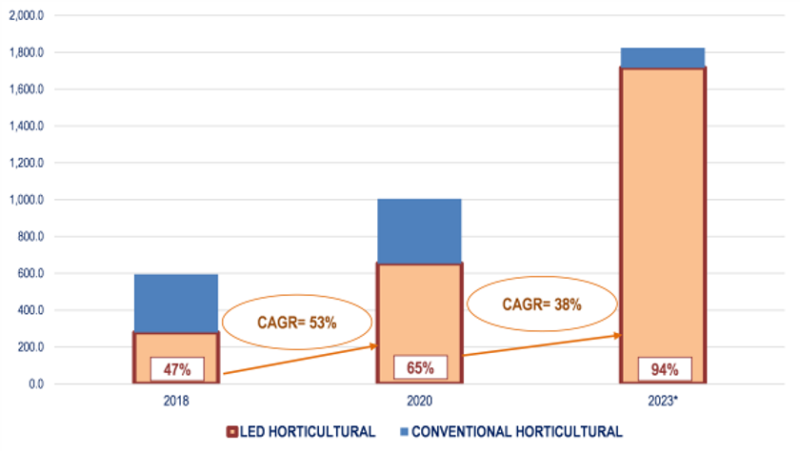
In terms of applications, in 2020 the global market for the horticultural market can be broken down in descendent order in greenhouse, cannabis, indoor and vertical farming and research.
The market is quite concentrated among the largest players. The top 10 largest players from the CSIL sample hold a cumulative market share of over 50%. Signify is by far the leading player with a market share of 14%, followed by Fluence by Osram and Gavita.
Contact us for further information about the report.
Cover photo credit: Signify