How can evaluation demonstrate for whom, when, and why interventions work — moving beyond simply proving impact?
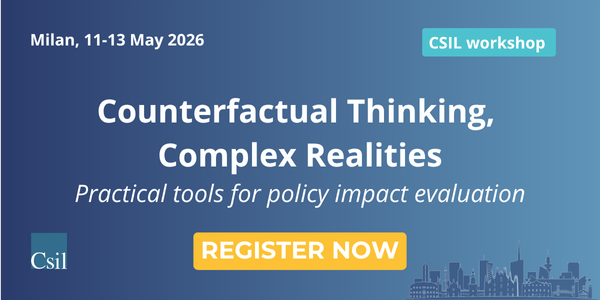
To address the complexity of real-world policy challenges, CSIL is organising a three-day workshop on Counterfactual Impact Evaluation (CIE) that brings together policy professionals, researchers, and evaluators to explore how to contribute to more nuanced, actionable, and context-sensitive evidence to support better policymaking.
Find out more about the workshop
📍Venue: NH Milano Machiavelli, Via Lazzaretto 5, 20124 Milan
(Centrally located, next to the Central Station, well connected by metro and train.)
📅Dates: 11–13 May 2026
🕓Format: 2.5 days | English | In-person event
🎓Target audience: policymakers, evaluation practitioners, researchers, and doctoral students.
👥 Maximum capacity: 30 participants.
The programme blends methodological sessions, hands-on group activities, and a policy roundtable with experts from European and national institutions. No advanced econometric background is required; sessions are accessible and practice-oriented. Participants are encouraged to bring a laptop.
All details about the workshop are now available online.
Participants can choose to attend the full three-day workshop or the final-day policy roundtable only.
An early bird fee applies until 15 January 2026.
For questions about the programme or organisation, please contact Jessica Catalano and Claudia Santoro at workshop@csilmilano.com.
The Horizon Europe project PathOS has reached its conclusion. Its mission was to trace the impact pathways of Open Science (OS) across research, the economy, and society. CSIL’s main contribution was the development and testing of a Cost-Benefit Analysis (CBA) framework tailored to Open Science.
While Open Science has been promoted for its transformative potential, systematic evidence of its economic impacts has often been lacking. CSIL addressed this challenge by designing a robust methodological framework that adapts the principles of CBA to the specific features of OS.
The framework provides a structured roadmap for identifying and quantifying both costs and benefits, always benchmarked against a counterfactual scenario without OS. This approach ensures that assessments are not only comprehensive but also comparable across different OS practices.
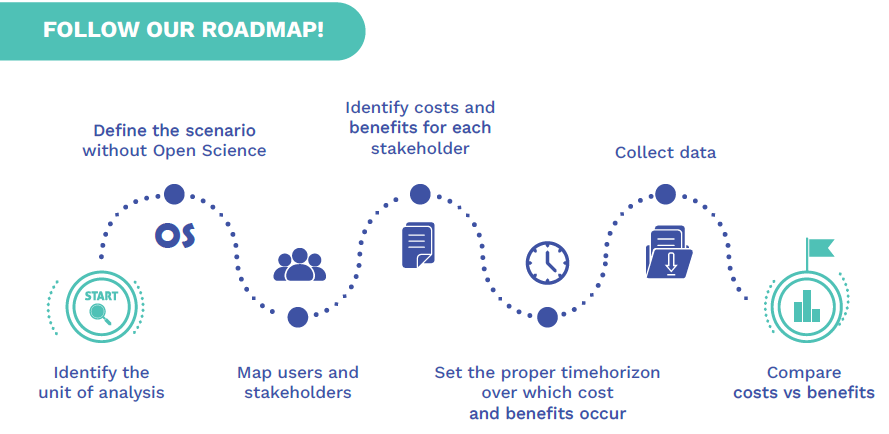
The framework is presented in detail in the PathOS methodological note (Deliverable 4.2) and summarised in the dedicated factsheet.
To ensure that the framework could work in practice, CSIL piloted it on two open science practices: UniProt, a global protein database, and RCAAP, Portugal’s national repository network. These pilots demonstrated how the methodology can be applied in real-world settings, accounting for diverse stakeholders and complex ecosystems. The insights are captured in two case study reports, alongside a synthesis, all available in Open Access and summarised in dedicated factsheets (UniProt factsheet | RCAAP factsheet).
CSIL has actively contributed to disseminating the findings and methodologies developed within the PathOS project through a series of presentations, workshops, and training events at national and international fora. Key dissemination activities include:
CSIL will continue to disseminate the results of PathOS to ensure that the evidence and tools developed through the project inform future research and policy work on Open Science
On 27 November 2025, CSIL will deliver a presentation on the CBA framework and findings from the UniProt case study at the European Conference of the Society for Benefit–Cost Analysis, organized in Athens. This session will highlight how the methodology developed within PathOS can be scaled to other Open Science initiatives and incorporated into broader evaluation strategies.
CSIL also ensured that results were accessible and actionable. PathOS work fed into global debates, with a dedicated study on the economic impacts of Open Science now published in Royal Society Open Science: The economic impact of Open Science. This study provides fresh evidence on how Open Science practices generate tangible economic benefits, contributing to more efficient, transparent, and impactful research and innovation.
In addition, CSIL has contributed to the scientific publication “Towards a Framework for Assessing the Economic Impacts of Open Science”, included in The Economics of Open Science 2.0 (Springer, 2024).
Further publications are currently under preparation to showcase the application of the CBA framework in practice, with the aim of supporting its uptake and adaptation in future Open Science evaluation.
The CBA framework for Open Science developed by CSIL is a practical decision-support tool. By making both costs and benefits visible, it empowers funders, infrastructures, and policymakers to design better policies, prioritise investments, and build credible narratives about the value of openness. Read it on Zenodo.
Accounting for nearly 15% of the global furniture market, the high-end segment represents a strategic driver of competitiveness within the international furniture industry. CSIL’s recent analysis, The World Market for High-End, Luxury & Design Furniture (July 2025), highlights how long-term structural dynamics, including the growth of high-net-worth individuals, the urban concentration of wealth, and changing consumer preferences, shape this segment’s resilience and transformation, even in times of economic and geopolitical uncertainty.

Cities are at the core of these developments. Global capitals such as New York, London, Paris, Milan, and Tokyo remain key hubs for design culture and consumption, while emerging urban centres such as Dubai, Mumbai, Shanghai, and Singapore are gaining importance through ambitious real estate investments, luxury tourism, and lifestyle-driven demand. This perspective shows how metropolitan areas function as both markets and incubators of design trends and brand strategies, making them pivotal to industrial and urban development dynamics.
The competitive landscape is highly diverse, ranging from artisanal workshops to international lifestyle brands. Distribution strategies, brand positioning, and geographic diversification are central to companies’ ability to succeed.
CSIL’s research findings show that:
In The World Market for High-End, Luxury & Design Furniture, CSIL methodology integrates market forecasts, structural analysis, and place-based insights. This includes:
With more than 200,000 millionaires and over 30 billionaires, London is the wealthiest city in Europe. It is a strong market and global hub for high-end furniture, hosting more than 50 flagship stores of leading brands, many clustered in the Brompton Design District.
→ Download the London City Profile
Further resources
We are seeking a Policy Analyst with 4–5 years of professional experience to join our Policy Advisory & Evaluation team. The successful candidate will contribute to high-profile assignments on the evaluation and impact assessment of EU legislation, ensuring our studies meet the highest analytical and methodological standards.
Please read the full vacancy and send your CV and motivation letter to careers@csilmilano.com or apply via the form on our website.
On 16 September 2025, CSIL will contribute to the Open Science Fair 2025 (OSFair2025), hosted at CERN in Geneva.
Jessica Catalano will present the Cost-Benefit Analysis Framework for Open Science, developed within the Horizon Europe PathOS Project. The presentation will highlight how evaluation tools and case studies can inform evidence-based policy and funding decisions, and support a better understanding of the societal value of Open Science.
The Cost-Benefit Analysis (CBA) framework for OS provides a systematic approach to quantifying impacts. Going beyond the measurement of benefits alone, it incorporates associated costs and enables meaningful comparisons with scenarios in which OS is not implemented.
The presentation will illustrate the key elements of this framework, focusing on the types of costs (e.g. set-up and maintenance) and benefits (e.g. cost savings) specific to OS, and the methodology used to quantify them. Within the PathOS project, CSIL has piloted this framework to evaluate the socio-economic impacts of two Open Science practices: UniProt, an open-access protein database, and RCAAP, Portugal’s national open repository network. The work is summarised in an open-access deliverable on Zenodo, which features case study reports as annexes.
The presentation will also address the challenges of applying the CBA framework and propose recommendations for mitigation strategies and actions, aiming to strengthen its role as a tool for evaluating the socio-economic value of Open Science resources and supporting evidence-based policy and funding decisions.
📍 Date: 16 September 2025
📍 Location: CERN, Geneva
Further details on the programme and registration are available via the following links:
The textile industry faces a well-documented yet often underreported issue: gender discrimination in factories. Despite widespread recognition of this problem, low reporting rates and insufficient documentation make it challenging for companies to develop targeted solutions.
As part of our work within the EU Textiles Ecosystem Platform, CSIL has identified the Gender Data Gap Partnership Initiative as a best practice in addressing gender inequality within textile manufacturing. Launched by the Partnership for Sustainable Textiles and supported by the German Federal Ministry for Economic Cooperation and Development (BMZ), this initiative is helping companies measure and improve gender equality across their supply chains.
In a pilot project conducted in Tunisia, the initiative introduced a two-level assessment system that gathered crucial data on:
The methodology employs specially trained, external female auditors who ensure that workers can speak freely in a safe environment, free from cultural or language barriers. This approach provides actionable insights that companies can use to improve workplace conditions for women.
The Gender Data Gap Initiative establishes a replicable model for companies to assess and improve gender equality in their supply chains. The project supports broader EU objectives for social sustainability and human rights due diligence, contributing to safer, healthier, and more inclusive working environments in the textile industry.
Cover photo by Allan Wadsworth on Unsplash
As global industrial and economic dynamics evolve, Africa is increasingly recognised as a continent of strategic importance. Its growing population, expanding urban centres, and rising digital penetration are transforming the continent into a hub for innovation, entrepreneurship, and sustainable growth. In this context, initiatives like BIC Africa, which supports the establishment and strengthening of business incubators, play a crucial role. Commissioned by the European Union and implemented by the European Business and Innovation Centre Network (EBN), BIC Africa provides business support organisations in Angola, Ethiopia, Madagascar, Somalia, and the Comoros with capacity-building, networking, and quality assistance. The aim is to improve market access, strengthen value chains, and create new business opportunities. Through a quality management system tailored for incubators, BIC Africa supports continuous improvement and the development of certification schemes, fostering more resilient innovation ecosystems.
As an associate member of EBN, CSIL provides analytical support and strategic insights for the project. Through research, benchmarking, and annual surveys of business support organisations, CSIL aids in interpreting country-specific data, with the potential to extend this model to other African nations, contributing to the development of innovation-oriented value chains and ecosystems that drive economic growth and regional development.
EBN is a not-for-profit that connects a pan-European network, using innovation to drive regional development. Its initiatives include quality business support programmes and EU|BIC certification, which supports start-ups, SMEs, and entrepreneurs with high-level business and innovation services. EBN also fosters global collaboration through its Special Interest Groups, which promote networking and knowledge exchange on topics such as sustainability, circular economy, and manufacturing. CSIL has been an associate member of EBN since 2019.
An article titled “Supporting Innovation and Capacity Building in Africa” is featured in the current edition (06) of World Furniture Online, CSIL's free magazine offering economic perspectives, market analysis, and data-backed insights drawn from CSIL’s international research and project work.
Read more on BIC Africa
As CSIL marks its 45th anniversary, the latest issue of World Furniture Magazine reaffirms the organisation’s commitment to providing clarity amid uncertainty across departments, sectors, and geographies. In her editorial, our Editorial Director, Giovanna Castellina, captures the spirit of this milestone:
"We live in a world shaped by complexity that makes the present a moving target and the future an intricate puzzle with no clear key (…) Despite this opacity, one thing remains constant: knowledge. At CSIL, we believe that understanding it is a necessity. Research, insight, and the relentless pursuit of clarity are not just responses to confusion; they are the only viable tools to decode it."
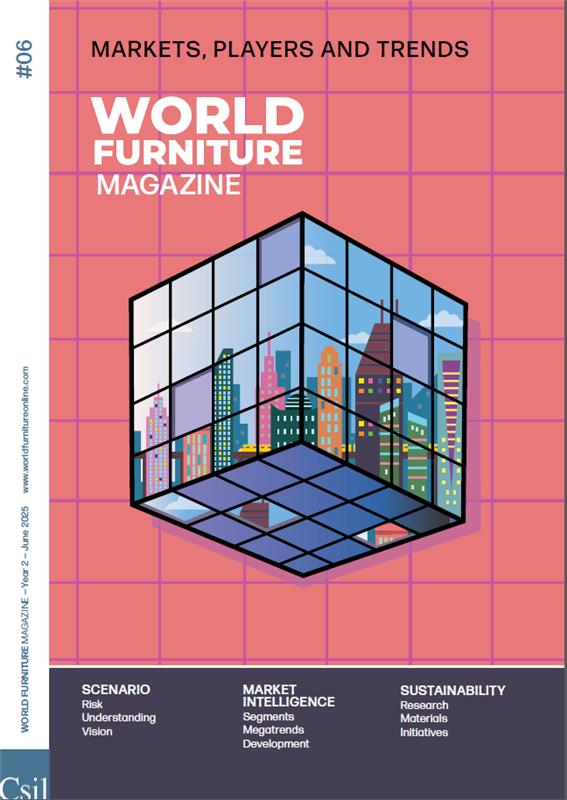
This is the guiding principle behind CSIL’s work and this magazine edition, whose cover — a reimagined Rubik’s Cube — visualises the balance between disorder and method, uncertainty and insight.
World Furniture Magazine #06 offers economic perspectives, market analysis, and data-backed insights drawn from CSIL’s international research and project work. The articles reflect a shared commitment across all CSIL teams: to interpret change in global trade, innovation systems, and sustainability transitions, and to provide decision-makers with structured knowledge in an increasingly complex landscape.
Some highlights include:
Download World Furniture Magazine #06!
At the end of 2024, CSIL kicked off a new project to support the European Commission DG GROW and EISMEA in rolling out the Textiles Ecosystem Platform, in collaboration with EY, SDA Bocconi, ITA Academy Gmbh, Hypertech SA, and Blumine Srl.
Our consortium has designed the platform to provide stakeholders in the textile industry with the knowledge, resources, and networks to help businesses transition towards greater sustainability, digitalisation, and competitiveness. It offers:
The platform’s launch will take place on 16 May 2025 from 10:00 to 12:00 CEST, and we extend the European Commission’s invitation to all interested parties! During the event, participants will receive an overview of the platform’s functions, including how to publish content, access funding opportunities, and connect with industry professionals.
A key feature of the event will be the Voices of the Ecosystem session, where leading experts in the textile sector will discuss the challenges and opportunities associated with the industry’s green and digital transitions.
The EU Textiles Ecosystem Platform is a direct response to the European Commission’s Transition Pathway for the Textile Ecosystem, published in June 2023. This roadmap outlines how the sector can become more sustainable, resilient, and competitive, and the platform plays a central role in supporting stakeholders through this transformation.
Click here to register for the launch of the EU Textiles Ecosystem Platform.

Over the next two months, the PathOS project training series will host free expert-led webinars designed to delve into the multifaceted impacts of Open Science—academic, societal, and economic—and methodologies for their effective assessment.
On 10 April 2025, Jessica Catalano will present the Cost-Benefit Analysis (CBA) Framework that CSIL developed as part of the project, illustrating its application in quantifying the impacts of Open Science. This session will explore how to evaluate Open Science’s benefits and costs, drawing insights from the project's case studies.
The one-hour free webinar, hosted on Zoom, will start at 10:00.
Register here to secure your spot: PathOS Training Session: Cost Benefit Analysis Framework for Open Science
Additional Training Sessions:
The full training series covers the different impacts of Open Science and how to effectively measure them. See the full list:
All webinars will be hosted on Zoom.
For more details and to register for these sessions, visit the PathOS Training Corner.